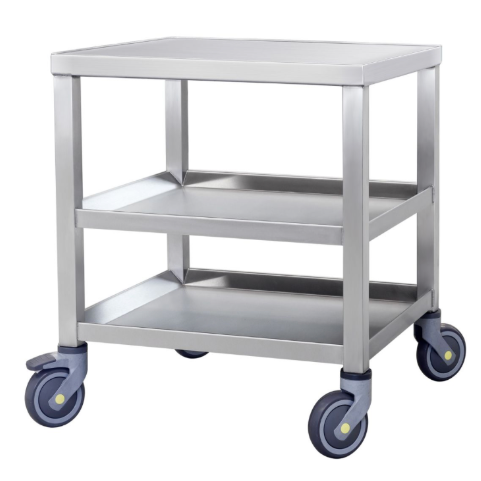
To choose a cleanroom trolley, start by describing the actual transport process. The load, required payload, route and cleaning method determine the configuration. Then review overall dimensions, shelves and castors together. A stainless steel frame alone does not answer these questions.
This guide helps cleanroom designers, technical teams and buyers prepare a useful enquiry. It identifies the information needed for an informed design discussion. Finally, assess whether the complete trolley suits the agreed application.
Choose a cleanroom trolley around the actual load
First, list everything the trolley will carry at the same time. Include containers, holders and accessories. Record their outside dimensions, individual weights and intended arrangement. A photograph of the existing loading situation often explains more than a request for a trolley with three shelves.
Also describe loading and unloading. Will closed containers stay on the trolley, or will operators remove individual parts during work? Do operators need access from one side or both? The answers affect clearances, handle positions and the arrangement of the shelves.
Next, include the following step in the process. For example, a transport-only trolley may differ from one that also provides a mobile staging area. If operators work at the parked trolley, identify the areas they need to reach before finalising the layout.
What payload should you specify?
Separate the total payload from the load on each shelf. State whether the load spreads evenly or rests on small contact points. For example, a heavy device standing in one corner presents a different design task from several containers spread across a shelf.
Castor selection considers the trolley’s own weight, its load and the number of castors actually supporting that load. Operating conditions also matter. Blickle therefore distinguishes, among other things, between dynamic and static load capacity. However, individual castor ratings do not establish the verified capacity of the complete trolley.
Describe any required reserve and foreseeable future use explicitly. A request for the strongest possible construction is difficult to assess. A documented maximum loading arrangement gives designers a clearer basis for coordinating the frame, shelves and castors.
How do the route and castors influence the choice?
Next, review the whole journey from loading to parking. Record tight corners, doorways, airlocks, floor transitions and the space available for turning. However, a parked trolley’s footprint differs from its manoeuvring envelope. Hands, handles and any projecting load also require clearance.
The type and arrangement of castors influence manoeuvrability. Describe the behaviour you need: long straight runs, frequent sideways parking or repeated changes of direction in confined spaces. Then assess the appropriate combination alongside the complete construction.
Include floor conditions, possible thresholds and the required parking arrangement at the workstation. Special requirements, such as electrical dissipation, need a separate specification and agreed evidence. Selecting suitable castors does not replace an assessment of the complete transport equipment.
What information belongs in the selection brief?
| Planning point | Information to provide | Purpose |
|---|---|---|
| Items carried | Dimensions, weights, quantity and arrangement | Define usable area and access |
| Loading | Total payload, load per shelf and distribution | Coordinate frame, shelves and castors |
| Route | Narrow sections, turns and floor transitions | Assess overall size and handling |
| Parking position | Available space and working side | Plan handles, parking and access |
| Cleaning | Method, agents and required access | Review materials and construction details |
| Documentation | Required records and acceptance criteria | Define the scope of supply |
How do you plan shelves and cleaning together?
Position the shelves around the items the trolley will carry. The space between two levels must do more than accommodate the height of a container. Operators also need room to insert, grip and remove it. Check these movements at the top shelf and below the lowest shelf too.
Also discuss whether the load needs rims, dedicated locations or holders. These features may position the load, while changing access and cleaning arrangements. For removable inserts, decide where operators will clean them and put them during that process.
Provide the planned cleaning and, where relevant, disinfection procedure. Therefore, review material, contamination and cleaning agent together. Information sheet 824 from Informationsstelle Edelstahl Rostfrei gives general technical guidance. For the specific trolley, include castors, plastics and other components in the review.
Who should agree the requirements?
Future users understand the handling steps and difficult passages. Technical designers check dimensions and interfaces. Quality or hygiene teams add the requirements of the operating area. Buyers then need a comparable quotation with a clearly defined scope.
Finally, bring those inputs together in one controlled version of the brief. Mark open questions clearly and identify a contact for technical coordination. This prevents conflicting requirements from developing across several separate email conversations.
A practical checklist for your enquiry
- Document the items carried, including dimensions, weights and loading arrangement.
- State the required usable area, overall dimensions and number of shelves.
- Give total payload and individual shelf loads separately.
- Describe the route, narrow passages, floor and parking position.
- Agree working sides, handles and the required parking arrangement.
- Provide cleaning procedures and any special material requirements.
- Identify drawings, supporting documents and acceptance points.
- Add quantity, place of use and the intended project schedule.
Which mistakes can you prevent early?
One avoidable planning mistake is selecting only by overall dimensions. Containers may fit, while leaving too little room for hands during removal. Similarly, a high overall capacity says little about suitability without a defined load for each shelf.
Avoid selecting castors from a single catalogue figure. The real route and loading conditions belong in the decision. Cleaning is another early planning task. If the project team discusses access or procedures only after manufacture, changes may be difficult to implement.
Frequently asked questions about cleanroom trolleys
Is every stainless steel trolley suitable for a cleanroom?
The frame material alone does not establish suitability. The complete configuration must fit its use, cleaning procedure and the operator’s requirements. Therefore, include castors, joints and accessories in that assessment.
How many shelves are useful?
The answer follows the items carried and the workflow. Additional levels provide more storage area, but may restrict access. A sketch showing typical loading helps identify a suitable arrangement.
Which castors are right for the project?
Selection depends on factors including load, route, floor, manoeuvring needs and cleaning. Describe those conditions so designers can identify suitable components and coordinate them with the trolley construction.
How do you request a made-to-measure trolley?
Submit the specific requirement with dimensions, sketches and a description of use. Then clarify technical feasibility and ensure the quotation records the agreed configuration.
Conclusion: understand the process before choosing the trolley
A useful brief connects the load, payload, route and cleaning procedure. It makes the properties needed for the actual task clear. Our overview of stainless steel transport trolleys provides a starting point for discussing the product.
Send dimensions, loading details and operating conditions through the KLEER project enquiry. Also list open points for clarification before agreeing on the final construction.